Category Archive:
Posted by George Peterson on January 5, 2012 at 5:08 pm

An annual pilgrimage for the auto industry is to attend the press days at the North American International Auto Show in Detroit each January. Unfortunately, this year I cannot attend because my physicians caution that I should not be heaving carry-ons into and out of overhead bins and baggage carousels.
So, I’m jealous.
One of the primary businesses of AutoPacific is to keep on top of what is the latest in the auto industry worldwide, so AutoPacific will still be well represented at Detroit.
I asked each of our staff members to remind me why I should or should not be jealous of them attending instead of me. Read below the break for their input.
Continue Reading
Posted by George Peterson on September 28, 2010 at 2:45 am

Think Audi A3, BMW 1-Series and Volvo C30 and you can better understand the competitive set Lexus is targeting with its all new CT200h 5-door hatchback to be launched in February 2011. Also think of the CT200h as a product really designed for the European market where it is right-sized and right-styled.
The competitive set in the USA sells less than 1,500 units per month now – or about 18,000 per year – small potatoes in a 12,000,000 unit industry. Lexus is going after 1,000 units per month – immediately intending capturing 40% of this small segment. Can they do it?
Given pricing in the low $30,0oo range, the CT will undercut the IS 250, but Lexus management tells us it won’t squeak in under the $30K barrier which could prove to be a psychological threshhold.
Continue Reading
Posted by George Peterson on March 2, 2010 at 11:15 am
Women owning HUMMERs have a strong affinity for ten consumer brands in the USA.
AutoPacific’s Research Suite database that annually collects the opinions of over 30,000 buyers of new cars and light trucks asked which of 27 brands a new owner would buy from. The results from AutoPacific’s Consumer Brands Study clearly show the interrelationship between owners of auto brands and buyers of twenty-seven consumer brands like Walmart, Lowe’s, Apple, Sony, Hugo Boss, Costco, McDonalds and more.
What the study shows is that you likely won’t find a Porsche driven by a woman in a Walmart parking lot, but you are likely to find a Land Rover driven by a woman at an Apple Store. Using these data AutoPacific can develop clear profiles of the dynamics between these auto brands and consumer brands.

Looking only at female buyers, HUMMER buyers were most likely to shop at Lowe’s, Old Navy, The Gap, Walmart and to buy Coca Cola, Levi’s, Axe, LG, HP and Hugo Boss.

The only other brand that came close to HUMMER gals was Land Rover. They were tops in Polo, Methoc, Sony, Gucci, Hugo Boss and HP. They were also in the top five among Trader Joe’s, Whole Foods, Apple, Starbucks, Costco and Louis Vuitton shoppers.
Continue Reading
Posted by Stephanie Brinley on December 21, 2009 at 9:12 am
Gradual Recovery Over the Next Five Years, But No Return to 17-Million Unit Years Anytime Soon
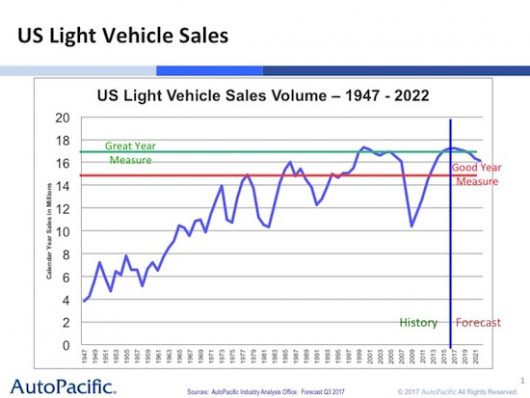
TUSTIN, Calif. (December 21, 2009) — 2009 will be a memorable year for the automotive industry — unfortunately for all the wrong reasons. The U.S. light vehicle market is expected to close out 2009 at a disastrous 10.3 million sales, down from 16.1 million sales just two years prior and the lowest industry volume since AutoPacific began forecasting automotive sales in 1988. Naturally, the national economic collapse had a profound impact on retail sales of light vehicles.
The industry can look forward to year-on-year recovery over AutoPacific’s five-year forecast period, but at a relatively gradual pace. In the near term, AutoPacific forecasts industry volume of 11.4 million units in 2010 as the economy slowly heals but also as unemployment hampers faster industry sales recovery. 2015 will see industry sales of 15.4 million, a significant improvement from 2009 volumes but still a far cry from the near-17 million unit years seen through much of the past decade.
Continue Reading
Posted by Stephanie Brinley on October 21, 2009 at 5:35 am
Survey Shows Generation Y Frequently Multitasking While Driving
TUSTIN, Calif. (October 21, 2009) — Willing to embrace new brands, new technology and alternative powertrains, Generation Y will redefine the automotive market. A just released study on Generation Y new vehicle buyers in the United States shows Generation Y consumers are more likely than the generations before them to consider purchasing a Chinese or Indian branded vehicle, more willing to accept hybrid powertrains, and more likely to want the latest entertainment technology in their vehicle. As the largest generation since the Baby Boomers continues to gain spending power and enter the new-car market, which automakers will win their confidence? AutoPacific’s study underscores the opportunities for automakers to reach Generation Y consumers as they move through their Teen, Young Adult and Young Family life-stages.
“Growing up with continuously evolving technology and electronics has given Generation Y a unique ability to adapt easily to change, a willingness to accept new brands, and an expectation that their vehicle provide the best of what is available,” said George Peterson, president of AutoPacific, the research firm that conducted the study. Though many Generation Y consumers would choose a trip around the world over a luxury vehicle, Generation Y does expect that the vehicle they buy will be more than just basic transportation. “Generation Y is more likely than older generations to own portable electronics, more likely to research their vehicle options on the Internet, and an astonishing 29%points more likely to frequently multi-task while driving. They know what’s out there, they know the economical and environmental problems we face, and their vehicle expectations reflect that knowledge.”
Continue Reading
Posted by Stephanie Brinley on September 9, 2009 at 5:29 pm
Survey Shows What Buyers Want – And Their Hesitation to Think Small
TUSTIN, Calif. (Sept. 9, 2009) – A just released study on the future of small cars in the United States shows American consumers are increasingly interested in smaller cars, but with reservations about size and features. The study underscores the challenge automakers face in trying to meet government mandated improvements in fuel economy while still delivering what consumers want and will buy. Many carmakers have recently introduced new, smaller cars to the market and are launching more in the future.
“Our research indicates that American car buyers are definitely willing to buy a more fuel-efficient car, but that they don’t want it to be much smaller than what they are driving today,” said George Peterson, president of AutoPacific, the research firm that conducted the study. “Tomorrow’s successful small car won’t be tiny. It will be reasonably sized, have increased fuel economy, adequate performance and a full load of customer features.”
Continue Reading
Posted by George Peterson on August 20, 2009 at 5:29 am
The Cash for Clunkers Program Ended at 8PM EDT on Monday August 24. According to government statistics, 680,114 Cash for Clunkers deals were made using $2.88 billion of the $3 billion authorized for the program.. The average clunker received a $4,235 rebate. Reimbursements are coming very slowly to dealerships and the government is putting more processors on staff to handle the backlog. Overall, a rare successful stimulus program.
On July 24, 2009 new car dealers in the United States began accepting trade-ins of older vehicles not worth much for new cars. Based on their fuel economy and the fuel economy of the new vehicle purchased, customers received a voucher for $3,500 or $4,500 to apply to the purchase of a new car or light truck.
Ultimately, the results of this program may be the sale of slightly over 700,000 new cars and light trucks with about 250,000 incremental to what would otherwise have been sold. But the impact goes deeper. There will have been substantial sales tax revenue from each sale going to states and cities that sorely need the income. Additional income taxes will be generated from the additional commissions and salaries dealership personnel otherwise would not have earned. The list goes on.
A brief synopsis of the impact of the Car Allowance Rebate System (CARS) is shown below the fold…
* * * * *
Continue Reading
Posted by George Peterson on June 5, 2009 at 9:39 am

General Motors’ June 1 bankruptcy declaration was quickly followed by the announced sale of HUMMER to China’s Sichuan Tengzhong Heavy Industrial Machinery Company (June 2) and Saturn to Roger Penske’s Penske Automotive Group (June 5). Having the futures of both of these brands out from under the General Motors umbrella can give many American dealerships and their communities cause for celebration.

Continue Reading
Posted by George Peterson on May 19, 2009 at 9:34 am

Hyundai is the winner of the first Rising Star Award from AutoPacific. The Rising Star Award is given to the brand climbing the most positions in AutoPacific’s Vehcile Satisfaction Award research. Hyundai climbed eleven positions year-to-year. This is testament to Hyundai Motor America and Hyundai dealers selling vehicles that satisfy their customers and good customer handling at the dealerships.
Hyundai had two category winning vehicles – the Hyundai Genesis won the Aspirational Luxury Car Category and the Sonata won the Premium Mid-Size Car Category.
Other Rising Stars were Infiniti climbing ten positions and Mercury climbing nine.
Continue Reading
Posted by Stephanie Brinley on April 20, 2009 at 2:40 pm
TUSTIN, Calif. (April 20, 2009) — A just completed national internet survey shows a marked increase in consumers’ unwillingness to consider purchasing a new car. Beginning in September 2008 AutoPacific, a Tustin, Calif.-based automotive market research firm, looked to its internet consumer panel to gauge the likelihood of consumers to purchase or lease a new (not used) vehicle in the next 24 months. The most recent survey shows those who definitely/probably will not buy has increased from 22% in September, 2008, to 38% in March, 2009 to 42% in April. This trend is reinforced by the survey’s definitely/probably will buy numbers which have decreased from 53% last September, to 37% last month to 35% in April 2009. Over 1,100 persons responded per survey.
“In early 2008 the US auto industry was hobbled by high gasoline prices, while consumer confidence was beginning its own collapse. Then, just as gas prices declined, the financial crisis hit, and vehicle sales fell even lower,” says George Peterson, president of AutoPacific. “A key component of AutoPacific’s sales forecasting practice includes monitoring consumer intentions on a regular basis. One might think that the government’s stimulus expenditures, warranty guarantees for GM and Chrysler vehicles, or the rising stock market would have turned consumer sentiment around. But this survey shows that hasn’t happened, at least not yet.”
Continue Reading